
As we roll through August, market volatility is picking up.
If you’ve been trading lately, you know that volatility can be both a challenge and an opportunity…
All depending on how you approach it.
So, how do you navigate these unpredictable times? It all comes down to knowing when to hedge and when to lean into the market’s momentum.
When volatility spikes, you’re often faced with a market that swings in both directions. This is where hedging comes into play.
If you’re holding positions in a market that feels like it’s on the edge, consider using hedges, like out-of-the-money Nasdaq 100 (QQQ) puts, to provide a cushion if things turn south.
A good hedge strategy can give you peace of mind while still allowing you to participate in potential upside when the market decides to bounce back. In volatile times, a hedge isn’t just a safety net — it’s an essential tool.
But not every volatile moment is one to hedge.
Sometimes, volatility can signal strong price action that favors the trend. Take a look at stocks like Nvidia (NVDA) or Meta (META) during earnings season. When momentum aligns with strong fundamentals, volatility often fuels moves to new highs.
In these situations, there’s no need to overcomplicate things with hedges — ride the wave.
Yes, volatility means bigger moves, but it also means bigger opportunities, especially for those of us trading short-term options.
The key here is to be selective. Volatility isn’t always about big swings… Sometimes, it’s about small but consistent moves that accumulate.
In these cases, I prefer to adjust position sizing rather than trying to predict every market flip. For example, during earnings season, certain stocks will move sharply regardless of the broader market’s direction. If you’re not hedging, keep your trades smaller and more targeted.
So, how do you decide whether to hedge or ride the trend?
Keep an eye on the market internals, sector performance, and earnings reports. If you’re seeing momentum on your side, take the opportunity to ride the wave. If the market’s direction feels uncertain, don’t hesitate to hedge and give yourself some protection.
In times like these, the flexibility to shift strategies can be your biggest advantage.
Apex Indicator: Costco (COST)
The markets are trying to bounce back from last week’s big fall, and we’re seeing some nice moves up in several places.
And that’s why using the Apex Indicator is helpful. A bullish Apex signal can let us know which stocks might be starting a move.
And Costco (COST) could be one of those stocks.
Here’s the chart:
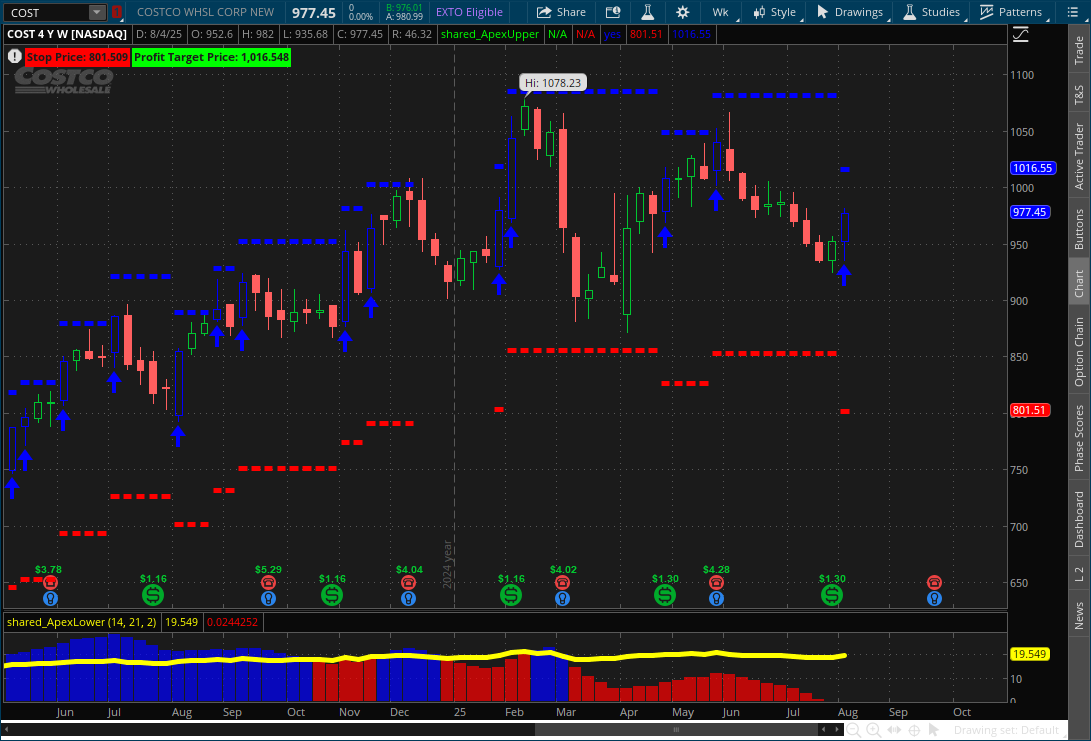
We have a new blue arrow after a recent pullback. And COST tends to move after blue arrows. A target would be up around the $1,016.55 level. A stop could be down at the $801.51level.
Remember, we enter these trades using wrap orders, and for more training on how to place wraps… go here!
That’s all for today. I hope everyone has a great weekend — join me and Nate at 10 a.m. ET weekdays for Opening Playbook, and then again at 3:30 p.m. ET for Closing Playbook!
Graham Lindman
Graham Lindman Trading
Follow along and join the conversation for real-time analysis, trade ideas, market insights and more!
Important Note: No one from the ProsperityPub team or Graham Lindman Trading will ever contact you directly on Telegram.
*This is for informational and educational purposes only. There is inherent risk in trading, so trade at your own risk.
P.S. Why Is No One Talking About This Trade?
I have to be honest with you. I’m kicking myself right now.
A few months ago, I got an email from my mentor, the 10x trading champ Chuck Hughes.

He told me he’d found a strange market phenomenon…
A way to place a single trade in the final minutes of the day and have a shot at waking up to hundreds of dollars the next morning.
He said it was the most consistent thing he’d seen in his 40+ year career.
And you know what I did?
I brushed it off.
As an options expert myself, it just sounded too simple. Too easy… So I filed it away and moved on.
Big mistake.
Because last week, I found out what Chuck did next… He taught the exact same method to his daughter, who works a full-time job and has barely ever traded.
He had her use her own money for three months to prove it works.
Her live results? A 78.4% win rate, of the 37 trades she placed, she won 29 of them!
We all know that no strategy wins 100% of time, but seeing an everyday strategy hitting winners on nearly 8 out of every 10 trades…that’s incredible!
Based on her real-time returns, anyone following along with a small $2k stake could have pocketed an extra $14,920.80, winners and losers included.
When I saw that, my stomach dropped.
That’s the kind of money that could have paid for a family vacation, padded a savings account, or just made life a whole lot easier for the last few months.
And I missed it because I thought the approach was too simple.
I immediately got on the phone with Chuck and told him he had to show my readers what he showed his daughter.
He agreed to do it one time, LIVE.
So, this Sunday at 7 PM ET, I’ll be sitting down with Chuck, and he’s going to pull back the curtain on everything.
While it’s common knowledge that no one can guarantee returns or against losses in the market…
This is your chance to see what I missed and set yourself up to target daily overnight income from the marketing without trying to bet on direction.
Tap This Link to RSVP for Sunday!
We develop tools and strategies to the best of our ability but no one can guarantee the future. There is always a risk of loss when trading. Past Performance is not indicative of future results. Since this is a tool designed to help traders make informed trading decisions the results will vary for each individual user as there are multiple trades to choose from. The majority of trades expressed are from historical back tested data unless otherwise specified in order to demonstrate the potential of the system. The average return per trade from the testing (winners and losers included) was 4.1% each day with an average winner of 24.2% and 78.2% win rate on over 300 signals between 8/2/23-7/25/25. Every example shown today is based on a $2,000 investment unless otherwise stated – but you don’t need that much to get started – the average cost is right around $200 per trade. We cannot guarantee any specific future results, as there is always a high degree of risk involved in trading
